The first Skye Terrier Breed Health Survey was open during 2025. The survey aimed to help us understand health conditions affecting Skye Terriers and inform conversations with the Royal Kennel Club and other Skye Terrier Clubs. The responses will help us to prioritise which health conditions to focus on and explore possibilities for screening and health tests, potential research and other actions we may be able to take to improve the health, genetics and longevity of Skyes.
Skye Terriers are a numerically small breed and this is reflected in the response rate to the survey, however, it has helped us to quantify some of the health conditions we know affect Skye Terriers. In total we had 124 completed responses from owners across the world – a huge thank you should go to everyone who took the time to complete the survey! Here’s a break down of responses:
- 124 complete responses
- 58 responses from the UK
- 66 responses from around the world
- largest international response rates from Finland, Australia and USA
- 47 responses reported no health conditions
- 77 responses reported one or more health condition or behaviour concern
- 24 responses recorded date of death
The survey asked about some known conditions and gave respondents the chance to report any other health condition. We asked specifically about:
- Puppy limp
- Undesirable behaviour
- Hemangiosarcoma
- Intervertebral Disc Disease (IVDD)
- Skye Terrier Hepatitis
- Liver disease
Here are some of the headline results – full results can be found in the Breed Health Survey Results PowerPoint (at the bottom of this page).
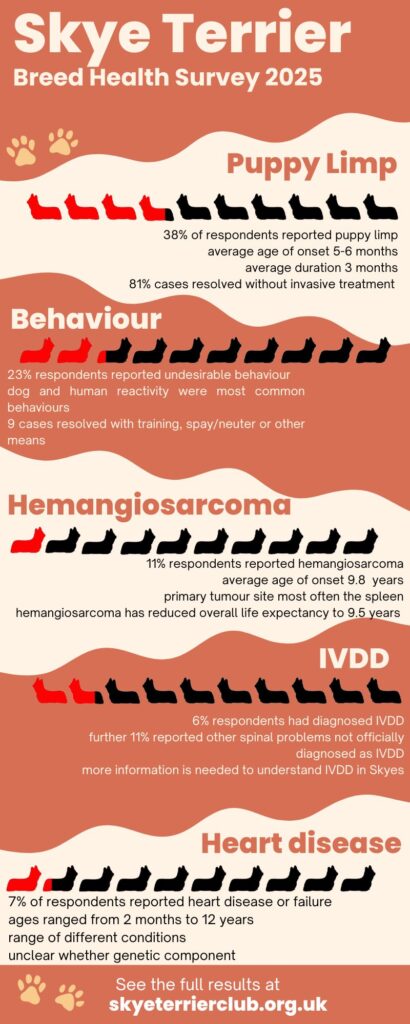
- 38% respondents reported puppy limp
- 23% respondents reported undesirable behaviour
- 11% respondents reported hemangiosarcoma
- 7% respondents reported heart disease
- 6% respondents reported IVDD
- 10% respondents reported other spinal issues not diagnosed as IVDD
- 4% respondents reported kidney disease
- 1 respondent reported liver disease
Puppy Limp and Elbows
From the respondents who reported puppy limp we were able to profile the average age of onset and duration, however there was considerable variation.
- On average, respondents started limping at 5.9 months old
- On average, limps lasted 3.2 months
- 81% of limps resolved with rest or conservative treatment
- 2 respondents required surgery for premature closure of the growth plates
- 4 respondents’ limp did not resolve, but they did not have surgery
36 respondents reported elbow grading scores – 12 of these had limped as a puppy, the other 24 had not limped as a puppy. Elbows were graded using a number of different grading techniques, but most used the INC Elbow Grading protocol developed by Dr Anu Lappalainen at the University of Finland. INC grades are:
- 0 = normal elbows
- 1 = mild incongruence
- 2 = moderate incongruence
- 3 = severe incongruence
Of the 12 who had limped, grades ranged from 0/1 – 3/3
Of the 24 who had not limped, grades ranged from 0/0 – 2/2
The only cases of 0/0 elbows reported were in dogs that had not limped
Although the relationship between puppy limp and elbow incongruence is not straightforward, the Finnish Elbow Project has demonstrated that consistent grading and breeding away from elbow incongruence can both improve score and reduce the number of puppy limping.
Behaviour
Although behaviour has a strong environmental element it is something that pose significant challenges for owners. 23% of respondents reported undesirable behaviour. Of these:
- reactivity to other dogs was most commonly reported
- reactivity to humans, shyness with humans and territoriality were the next frequently reported
- 9 respondents stated the behaviour was rectified through training, spay/neuter, or other unspecified means
- 13 respondents stated the behaviour did not resolve and were comtinuing with training and socialisation
- 1 respondent reported the behaviour was due to a brain tumour
With the exception of the respondent who reported a brain tumour, the behaviours reported were behaviours commonly observed in other breeds and were not reported to be extreme. However, the fact that many did not resolve suggests that support, advice and guidance on socialisation and training may be needed.
Hemangiosarcoma
10 respondents reported hemangiosarcoma.
- average age of onset 9.8 years (range: 8-12 years)
- primary tumour site most commonly the spleen
- 2 further respondents reported tumours of the spleen that were not diagnosed as hemangiosarcoma
- hemangiosarcoma is always fatal
24 respondents provided a date of death in the survey and 10 of these died from hemangiosarcoma. From these 24, the average age of death was 9 years old. This is however, heavily skewed by the 10 early deaths caused by hemangiosarcoma.
Heart Disease
7 respondents reported heart disease or failure. This included a range of different disorders and ages of onset. Conditions included:
- Pulmonary stenosis
- Congenital cardiomyopathy
- Mitral valve disease
- Heart failure cause not specified
- Atrial fibrilation
- Heart murmur
Age of onset ranged from 2 months – 12 years
Although there is no pattern to the diseases reported, many are structural or congenital (present at birth). More information is needed to understand whether there is any hereditary risk and it may be advisable to have breeding dogs’ heart function checked prior to breeding.
IVDD
IVDD risk is associated with the gene for chondodystrophy (CDDY). This is a gene we know is present in Skye Terriers.
6 respondents reported IVDD with symptoms ranging from moderate to severe, with some requiring surgery. A further 10 respondents reported spinal issues that weren’t diagnosed as IVDD. These included:
- lameness
- paralysis
- ruptured discs
- acute injury to the back or spine
One respondent reported having the dog’s spine graded. Without grading or diagnosis it’s not possible to tell whether these general spinal problems were caused by IVDD. More information and perhaps a grading scheme is required to understand the IVDD risk for Skye Terriers. While the breed appears to be less affected than some breeds we don’t know whether low-grade IVDD is present without causing significant symptoms.
Recommendations
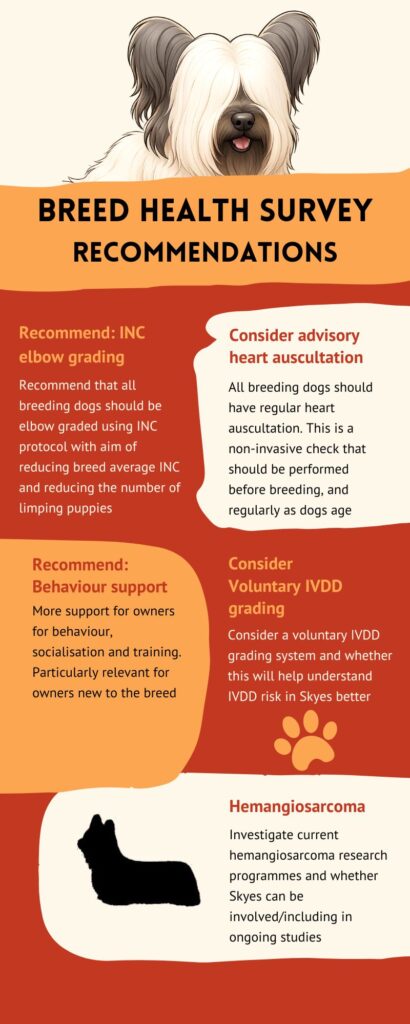
There are some key recommendations to take from the Breed Health Survey Results:
- Standardised elbow grading using the INC protocol should be recommended for all breeding dogs, with the intent of breeding away from elbow incongruence
- Heart auscultation should be considered as an optional test prior to breeding
- A voluntary IVDD grading scheme should be considered to better understand the IVDD risk for Skyes
- Behaviour, training and socialisation support should be considered, particularly for new owners
- Skye Terrier Health Committee should investigate current hemangiosarcoma research in the UK to see whether Skyes can be included or benefit from existing projects